CULTURE
The silence that moved millions and gave the DRC a voice once more
Michel Kuka, known as Lumumba VEA, made his mark on the 2025 Africa Cup of Nations through his powerful silence. A cultural icon and a source of soft power for the DRC.
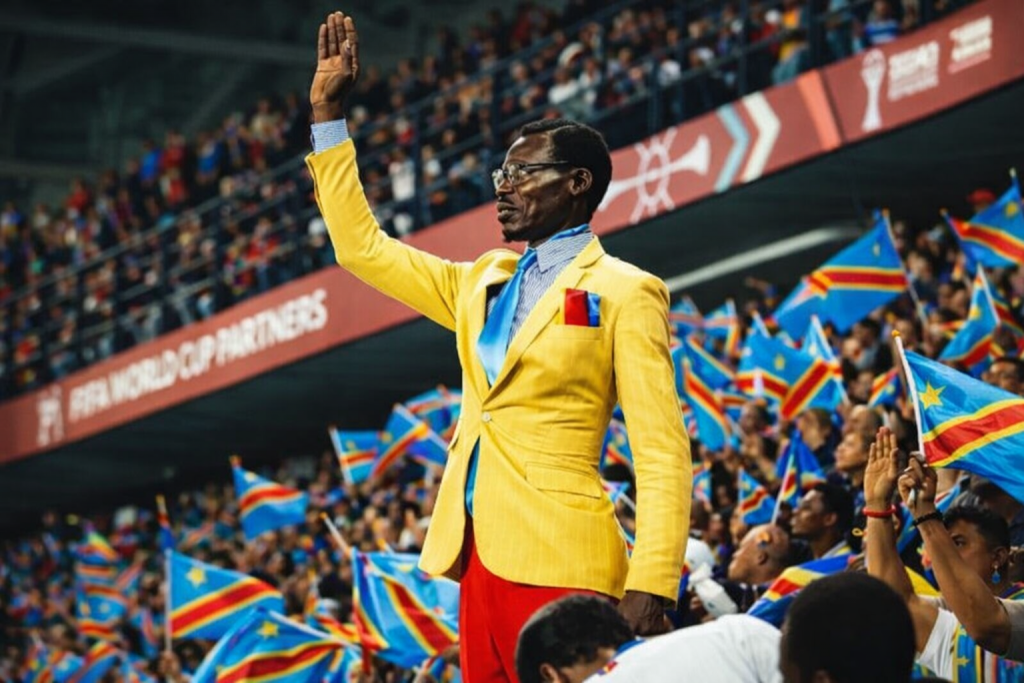
His name is Michel Kuka. But the world came to know him by another name: Lumumba VEA.
A stage name, almost a manifesto. A name steeped in history, memory and dignity.
At the 2025 Africa Cup of Nations, in a stadium filled to bursting with shouts, chants and waving flags, this man became a global phenomenon by doing exactly the opposite: he stood still and silent.
And yet, rarely has silence spoken so loudly.
Michel Kuka, alias Lumumba VEA, is not a supporter like any other. Draped in the Congolese flag, standing tall, gaze fixed, arm raised, he embodied far more than sporting support. He carried a collective memory. That of Patrice Emery Lumumba. That of a country often reduced to its crises, but whose symbolic depth remains immense.
This gesture, widely reported by African and international media, transformed a football match into a global cultural event. No slogans. No speeches. No provocation. Just a presence.
In an age dominated by visual and auditory excess, Michel Kuka reminded us of a simple truth:
impact does not always depend on the noise one makes, but on the meaning one conveys.
His stillness caught people’s attention. His silence unsettled, provoked questions and moved people. On social media, in the stands, in newsrooms, the same question kept coming up: Who is this man? What does he represent?
The answer went far beyond football.
Lumumba VEA wasn’t there to entertain. He was there to embody. To remind us that the DRC has a history, a political memory, and a dignity that cannot be compromised. Even — and especially — in popular spheres such as sport.
When the Leopards were knocked out and Michel Kuka broke down in tears, the symbol became human.
He was no longer just Lumumba VEA, a frozen, iconic figure. He was a Congolese man. A man. A heart.
Those tears moved millions of people because they were genuine. They spoke of hope, faith, disappointment — but also of a deep love for a country that one supports even when it falls.
This is precisely where Michel Kuka’s strength lies: he never played a role. He was sincere. And that sincerity travelled faster than any communication campaign.
What Michel Kuka, known as Lumumba VEA, achieved instinctively is soft power in its purest form.
No budget.
No institution.
No official strategy.
He projected a powerful image of the DRC:
that of a country conscious of its history, capable of producing powerful symbols that are respected and understood far beyond its borders.
The international reaction — right down to the official apology from the Algerian Football Federation — shows just how much cultural symbols can influence relationships, perceptions and narratives.
What the DRC can learn from Michel Kuka
- Celebrating its living symbols The DRC is brimming with cultural, artistic and popular figures capable of conveying a powerful message. But we must recognise, support and protect them.
- Reconciling youth and memory
By linking sport – a modern and popular arena – to the memory of Patrice Lumumba, Michel Kuka has made history accessible, alive and tangible. - Investing in confident cultural diplomacy
Music, sport, art and symbolic gestures can sometimes do more for a country’s image than rigid political speeches.
Michel Kuka, alias Lumumba VEA, did not speak.
But he said what mattered most.
And perhaps this is how true soft power begins:
when a silence sincere and deliberate touches millions.
DIASPAT NEWSLETTER
LET'S STAY IN TOUCH
SIGN UP FOR THE NEWSLETTER